Digitising the Past: A Volunteer’s Work with Historical Diaries
By David Hendy, museum volunteer
The museum has within its archive in excess of 125 original diaries covering life in the 24th Regiment in peace and war. Diaries vary between war diaries of one of the Battalions, through diaries of individuals (mainly officers since for many years other ranks were forbidden from keeping diaries in case if they were captured or killed and the enemy obtained the diaries they would gain operational intelligence).
The diaries range from the Sikh War of 1849, the Anglo-Zulu War, Victorian soldiering, the 2nd Boer War, World War 1 and 2, the North-West Frontier of India in 1937 fighting the Faqir of Ipi and the Korean War.
Challenges in transcription work
Some of the earlier diaries have suffered from the conditions in which they were written, in parts indecipherable and very fragile. For the last few years I have been transcribing the diaries in the hope that they can be put online and readily accessed to be of use to anyone looking to research a particular event or relative. There is a long way to go (I am currently on diary 31!) but it is a very interesting task.
The main problem is the legibility of some entries and idiosyncrasies of spelling, often it is necessary to refer to regimental records, atlas’ etc to pin down exactly where an event described is taking place. There is an immense feeling of satisfaction when it is possible to identify a particular indecipherable location!
The style of the diaries varies from the dry as dust recital of facts of the War diaries at one extreme, through the more vivid accounts of individual soldiers to the frankly implausible accounts generally prepared a substantial time after the events allegedly described.
Some Favourites: Diary of W. Spottiswood-Sparkes
Favourite diaries so far include that of the fantastically named Lt Col W Spottiswood-Sparkes from 1881-1906. He was one of history’s “nearly” men – at the periphery of major events but never the main player. His career suffered because, while in Africa, he had an affair with the wife of an American Federal General who was at the same time having an affair with the senior Civil Servant in the country who blighted his promotion prospects. The lady in question, following the death of her husband, amusingly abandoned both her suitors and married a Peer of the Realm. Sparkes died as he lived – on the polo field in 1906.
Diary of Wilfred Heaton
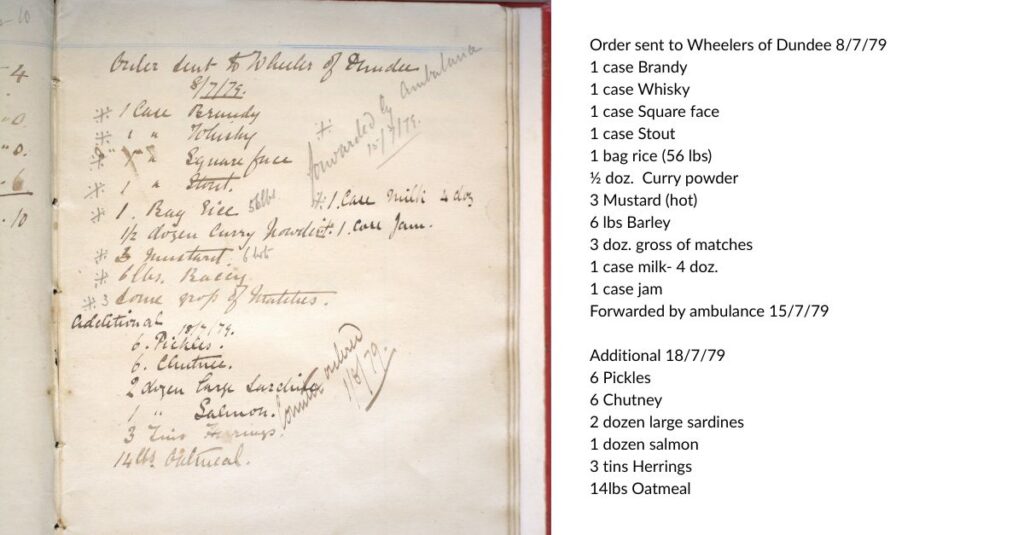
Another memorable diary is that of Wilfred Heaton. He joined the Regiment in 1874 and retired at Lt Colonel in 1896. His diary covers 1879 in South Africa and contains some interesting snippets of life at that period and indicates the “essentials” required by an officer on campaign :-
Diary of W.J. Furlonge
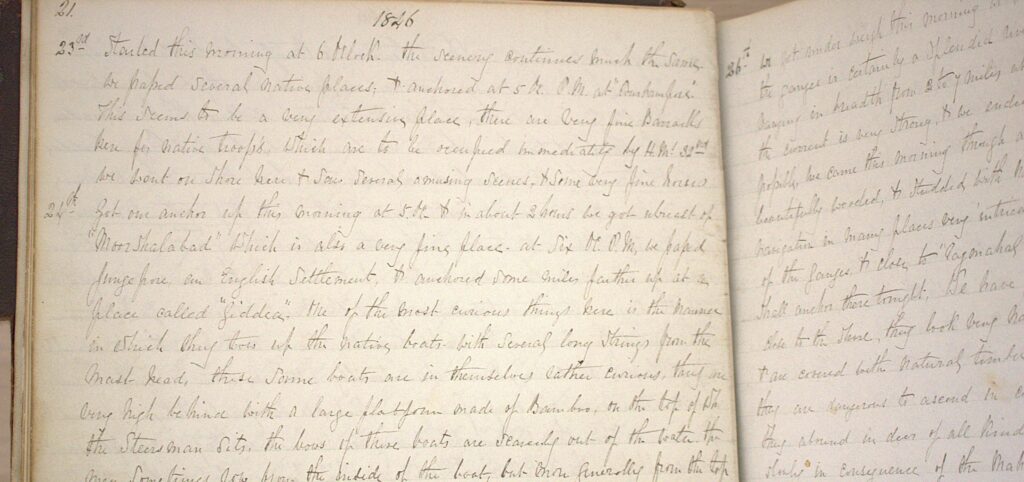
My favourite diary so far is, however, that of Surgeon W J Furlonge from 1846-49 which covers the Anglo –Sikh Wars in particular the Battle of Chillianwallah in 1849. At this battle, both the Colonel of the Regiment Pennycuick and his son the junior subaltern were killed. The Commander of the 2nd Division – Sir Colin Campbell of Peninsular War fame said in relation to the Regiment’s performance “It is impossible for any troops to have surpassed…the gallantry displayed in this attack. This single regiment actually broke the enemy’s line and took the large number of guns in their front”.
Surgeon Furlonge died in 1851 and in 1936 it was sent to the Regiment with a covering note:
“I have sent the diary by Parcel post and hope you will receive it safely, it was gave to me by our old night watchman in the Place with some other books. He was at Messsrs Cox and Co Charing Cross for some years as a messenger and they used to have an annual clearing out of books and papers which had not been claimed by friends of deceased clients and he took it home to read and kept it till he gave it to me, and I think there could be no relations alive who would remember this deceased gentleman, thought it would be more interesting to the regiment than anyone else. I shall not see the old chap for a few days as he is in St Thomas Hospital and expecting to undergo an operation of some internal complaint else I could ask him for more particulars about the Diary.”
Interested in Volunteering?
Would you be interested in similar volunteering or would like to be involved in another way? Check out our volunteering page for more details. We would love to hear from you!
