
10 July 1916 - Second Phase: Capture of the Wood
The second phase began on 10th July, when Major-General Watts was given the authority to create his own plans for the capture of Mametz Wood, unlike his predecessor Brigadier-General Evans. This change of authority was due to the disastrous attack on 7th July which was caused by communication issues between the division Headquaters at Pommiers Redoubt and the Frontline. Major-General Watts was selected as the new authority due to being the commanding officer responsible for the capture of Mametz village the previous week. His plan involved attacking at first light on 10th July and advancing to the edge of the wood at 04:15 under a smoke screen. Once in the wood, they would advance following a rolling artillery barrage. If the plan was executed perfectly, the wood would be under British control, just four hours later, at 08:15. Fortunately for the Major-General, the plan was relatively successful. Unlike the attack on the 7th July, Welsh divisions managed to make it to the edge of the wood. However, once there, conditions in the wood were worse than anticipated with a thick and dense overgrowth as well as collapsed trees from shelling blocking pathways. John Daniels, a veteran of the 38th Division remembers his entry to the woods:
Transcript:
“We came against resistance owing to the barbed wire it had been cut in many places, but otherwise in some parts intact. The German trenches on the west side of the wood and they were reinforced by machine gun placement there were no barbed wire entanglement at the edge of the wood, but there were many Germans lying dead, or almost, at the same part where we mentioned the pillboxes stand with their machine guns. When I entered the wood with my observation officer, with my partner of course we were two going along with an observation officer at all time.
As far as I come to remember Mametz Wood was not there at all, because it was in semi darkness and only stumps of wood we could see in front of us, I can’t remember much undergrowth especially in some parts of the wood…”
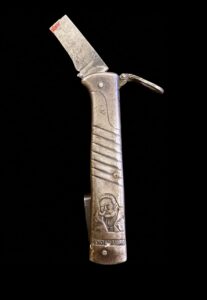
[Images of the Wire Cutters, Revolver, and Pickaxe]

Throughout the day the division fought their way through the wood facing heavy artillery and sniper fire. The German snipers were renowned for their skill, and would identify and target officers from their uniforms, this caused confusion and disorganisation of the British troops as the battalions mixed. Despite this, by the evening at around 17:40 divisions in the wood had managed to fight their way to the North of the wood despite the poor conditions and hand-to-hand combat. At a round 20:00 divisions began to work their way to the western side of the wood, however they discovered the Germans had reinforced their position. This forced British troops to fall back to the line they had created in the middle of the wood, where they came under artillery and sniper fire through the night.
Lt. Col D.F. Harvey remembers the fighting on the 10th July, having written a short account in his diary describing his instructions, and the officers from his battalion killed:
[Image of Diary 10th July Page]
Transcript of Lt. Col. Harvey’s Diary
Battalion stood to at 3am & stood down directly after, had orders at 11am to proceed to Pommiers Redoubt & stayed there for about 1 hour, water & wine fatigues were found [?] to about 100 men. 100 men of A trench went to Caterpillar Wood & 2 machine guns at 1 pm received orders to go & attack south east edge of Mametz Wood, we attacked it by bombing & going around enemy’s flank & suffered a fair number of casualties 2/Lts Everton & 10th Taylor were killed. The Bn took position in the A trench for the night, snipers were very active.
As fighting continued on the 11th July, British troops were increasingly exhausted, and confusion around British and German positions made it increasingly difficult for the British artillery to support the attack. When the Shells fell short or were on a low trajectory, they could strike British positions or strike the treetops. However, despite the friendly fire, and the low supply faced by the welsh divisions in Mametz Wood, they were successful in pushing to the Northern edge of the Wood, and secured their position by nightfall. Throughout the course of the night on the 11/12th July the Welsh Divisions were relieved of their positions by the 21st Division. The 21st Division found little resistance to them on the 12th July, as over the course of the night, the German divisions had evacuated from their positions in the wood.
Ultimately, the Welsh divisions were successful in capturing the Woods, however they suffered from a high number of casualties. Due to their depleted numbers the 38th Welsh Division would not see conflict again for some time. Additionally, despite capturing the wood, at the time the attack was seen as a failure by Military High Command, as their inability to capture the woods initially on the 7th July gave the Germans the time to reinforce their line in other locations, preventing further offences.